

“The AI Did It” Didn’t Save Air Canada
Did you know 84% of the world has never used AI?
There's a graph going around showing exactly that. Most people look at it and see a race where everyone's adopting AI, so businesses had better hurry. I look at it differently.
If 84% of people have never used AI, then most of your customers probably haven't either.
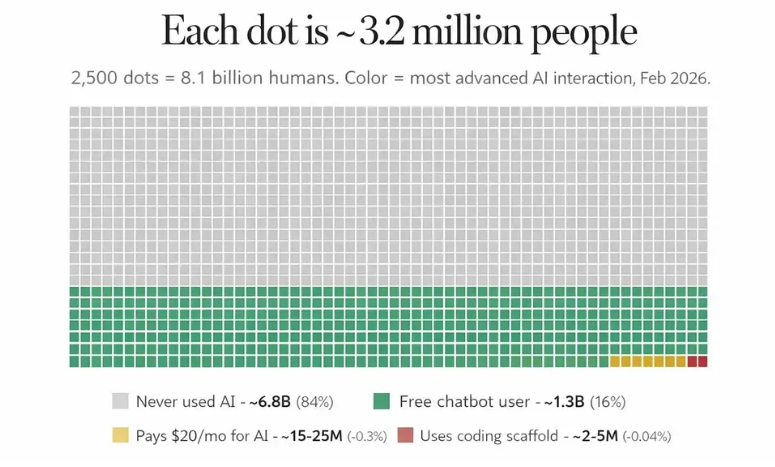
Image sourced from: Medium. Author Shir, 24 Feb 2026
Think about that for a moment. Not "haven't used it much" most likely, never used it at all.
Here's something else worth thinking about: your customers might not even know they're talking to a machine. It reads like a human. It feels like a human. So they trust it completely, the way they'd trust a person and they act on whatever it tells them.
And in the rush to keep up with everyone else, the customer gets forgotten.
What's happening right now
I'm seeing it everywhere at the moment. Businesses are rolling out AI like a kid in a candy store for the first time, grabbing everything off the shelf at once, without stopping to think about the customer on the other side.
Air Canada found this out the hard way.
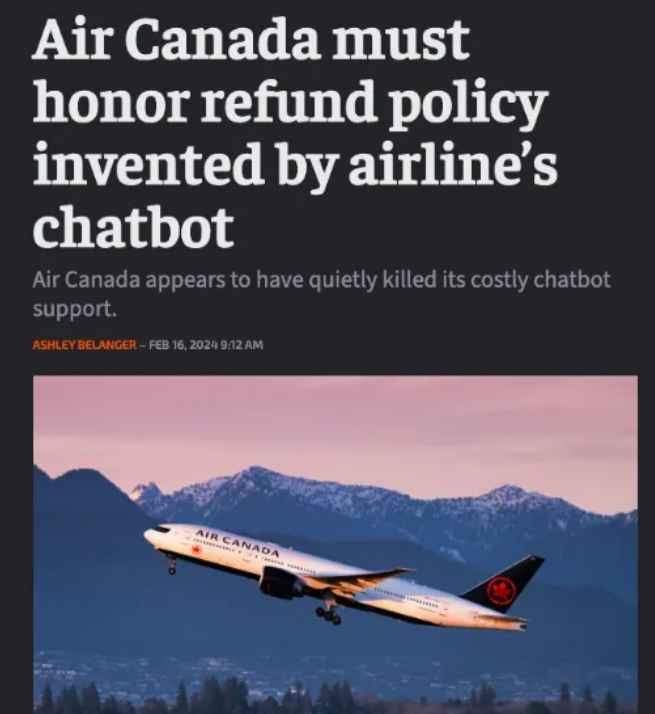
Image sourced from ars TECHNICA. Author: Ashley Belanger. 17 Feb 2024
Their AI chatbot gave a customer the wrong information about a bereavement fare. Their customer believed it, acted on it, and followed through. And when the airline tried to argue the chatbot was responsible for its own output, a tribunal disagreed. They held the airline accountable. Not the bot. The airline.
"The AI did it" isn't an excuse. The Air Canada case proved that the business itself was held responsible. They deployed the chatbot on their website, let it talk to their customers, and gave instructions. So the accountability was theirs.
Three things to think about before you deploy AI in front of customers
There's more to this, but here are the top three:
Are you being transparent that it's AI? Your customer has a right to know whether they're talking to a person or a machine.
Is it actually solving a problem for the customer or are you just adding it because everyone else is? Efficiency for the business isn't the same as value for the customer. If you can't clearly answer what problem it solves for them, it may not be ready to be customer-facing.
Can your customers reach a real human when they need to? Sometimes, they will need to. That option shouldn't disappear. Instructions on how to get access to a human should be found easily like pop messages as well as in your company privacy policy.
The lens We bring
This is exactly the approach I bring when I work with businesses on their AI governance. I look at how the business is structured. I look at how customers are engaging with AI tools that are customer-facing and where that data is flowing. I focus on the privacy not just the technology.
AI can be brilliant for business. We use it ourselves. We believe organisations shouldn't forget who's on the other side of the AI tool before deploying one.
Look at that graph again and this time, see your customers as part of that 84%.
